| |

Welcome
|
CONGRATULATIONS GRADUATES!
|
|
Reception immediately following commencement Sturges 005
For graduates and their families
|

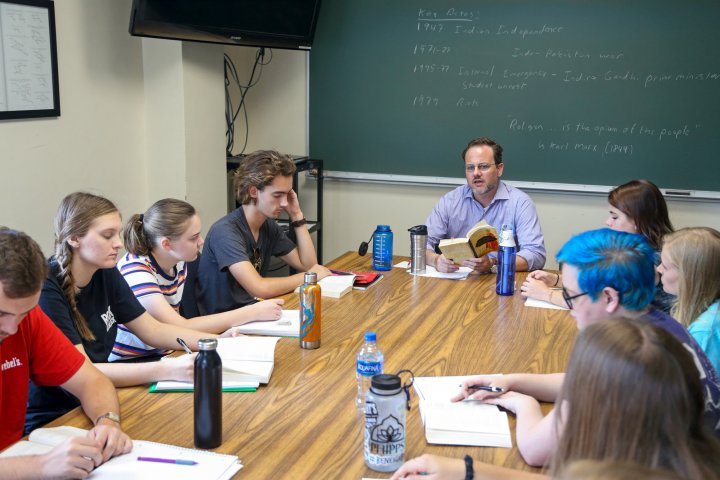
HERE IN THE English Department, we love the English language and the many things that it can do. Experts estimate that about 750 million people worldwide speak English, and English represents the first language of about half that number. In their 2002 book, The Story of English, Robert McCrum, Robert MacNeil, and William Cran report, “English at the end of the twentieth century is more widely scattered, more widely spoken and written, than any other language has ever been. It has become the language of the planet, the first truly global language.” In his 1990 book, Mother Tongue, Bill Bryson extolled the richness of the English language, with its 200,000 words in common use—more than twice as many as French. These words are the foundation of pleasurable reading and viewing—of stories, poems, plays, essays, and films that can enthrall and entertain us, move us, engage our intellects, delight our senses, and offer us wisdom and insight into the human condition.
Moreover, pleasurable reading often stimulates pleasurable writing. All writing, even writing on the most serious of subjects, is a form of word play in which the writer manipulates language in order to shape a reader’s response. In this sense, all writing is creative. But writing is also a skill that can be developed with instruction and practice, not merely a gift from the gods, your genes, or your first-grade teacher. And as most paper-writers know, writing is also an instrument of discovery; writing about something hones your analytical thinking.
Most people are more emotionally attached to their language than they realize. If you’ve ever argued passionately with someone over the correct name for a flavored, carbonated beverage, you know what we mean. In the English Department, we are unabashed language enthusiasts, and if you love to read and write—and analyze, criticize, discuss, and debate what you read and write—we invite you to join us.
We often hear, “I’d like to be an English major, but …” or “I should have been an English major!” So if you think that an English major is too much fun to be practical, keep reading.
What Our Alumni Say
In spite of the fact that I was heading for a career as a physical education teacher (I have a double major), encouragement from my professor in the English department inspired me to earn my MA degree…and to launch a second career as a travel writer. I couldn’t have asked for a more rewarding life. Diana Cottle Gleasner, Class of ’58, free-lance writer and author of children’s books
I believe being an English major is one of, if not the best, undergraduate training you can have for law school. You know how to identify issues, what is important and you can communicate it properly in writing. The communication and analytical skills you acquire are valuable in any field. Dean Chimples, Class of ’70, attorney and banker
When I was hiring writers and producers, English majors were high on my list. The young people who major in communications know how to push the buttons and move the cameras, but some of them don’t know where the library is. Virginia Bartlett, Class of ’44, television writer and producer.
The most useful thing that I learned as an English major is how to write and talk “on my feet.” So much of my professional career involved being able to communicate my ideas in an accurate and efficient manner. Kathy Stegbauer Restle, Class of ’89, retired school principal
That English major got me my first three jobs: at Harvard University Press (book promotion), Harvard Medical School (research and editing a professor’s manuscript), and Sunset Magazine and Books (book promotion). Each position involved writing and editing. Susan Allen Brooks, Class of ’70, elementary school teacher
I…can attribute much of my success to my ability to communicate with various groups of people with very different perspectives. Amy Johnson Beck, Class of ’85, banker
It’s not so much the content of what I learned, but the ability to learn more and see patterns in information that others don’t necessarily see. I feel like writing gave me analytical skills that a lot of other people lack. Michael Colson, Class of ’91, higher education administrator
The skills I developed as an English major at OWU have been put to good use critiquing resumes, developing web pages as a Content Manager for the Heidelberg Web site, and even co-writing a textbook used in Career Exploration courses. Kristen Lindsay, Class of ’92, higher education administrator
I’m STILL glad I didn’t give up my English major. It’s been the best thing that ever happened to me, intellectually speaking. Elizabeth Sykora Kirchner, Class of ’92, nurse practitioner
What can you do with an English major?
Evidently, anything you like.
Once thought to be the exclusive province of future teachers and lawyers, the English major has become an important foundation for a wide variety of careers. The reading and writing that English majors do build communications skills that make them attractive job candidates, especially in a twenty-first-century global economy dependent on the Internet. These skills also provide English majors with flexibility as the economy changes. A 2004 survey of 1200 major American companies conducted by the National Commission on Writing concluded that two-thirds of their salaried workers were required to write on the job, and writing was labeled a “threshold skill” measured in employee hiring and promotion. In a second survey of state governments, one hundred percent of personnel managers reported that writing was an important skill.
Reading skills are also important. Arkansas Governor, Mike Huckabee, vice-chair of the National Governors Association, observed: “It’s impossible to calculate the ultimate cost of lost productivity because people have to read things two and three times.”
A 1999 article, “Core Subjects and Your Career,” published in the Department of Labor’s Occupational Outlook Quarterly, noted: “Good communication is essential for most occupations, even those that require little interaction with others.” A list of more than fifty job titles requiring ‘advanced communication” skill ranged from administrative services managers to geologists, physicians, meteorologists, social workers, and urban planners. According to projections by the Office of Occupational Statistics and Employment Projections, of the twenty occupations predicted to have the most openings for college graduates up to 2014, 70% require advanced communication skills.
But that’s only the beginning.
What Can You Do with an English Major? Evidently, Anything You Like.

- Donald Regan, Treasury Secretary
- Sherry Lansing, CEO Paramount Pictures
- Clarence Thomas, Supreme Court justice
- Theodore Geisel (Dr. Seuss), children’s book author and illustrator (The Cat in the Hat)
- Diane Sawyer, television journalist, anchor
- Philip Larkin, poet (The Whitsun Weddings), jazz critic
- Martin Scorsese, director (Taxi Driver), screenwriter, producer
- Jon Meacham, editor (Newsweek), nonfiction writer (American Lion)
- A. Bart Giamatti, President of Yale, baseball commissioner
- Michael Eisner, CEO of Disney
- Junot Díaz, novelist (The Brief Wondrous Life of Oscar Wao)
- Judy McGrath, CEO MTV
- Eric Shinseki, Secretary of Veterans Affairs
- Cindi Leive, Editor-in-Chief, Glamour
- J. M. Coetzee, novelist (Foe)
- Kathryn Fuller, CEO, World Wildlife Fund-U.S.
- Chevy Chase, comedian, actor
- Allen Ginsberg, poet (Howl)
- Joan Rivers, comedian
- Carol Gilligan, ethicist, psychologist (In a Different Voice)
- Alan Alda, actor, director, screenwriter (M*A*S*H)
- Herb Scannell, Vice-Chair, MTV
- Pete Wilson, Governor of California
- Matt Damon, actor, screenwriter (Good Will Hunting)
- Harold Varmus, cellular biologist, director of the National Institutes of Health
- Linda Greenlaw, fishing boat captain, writer (The Hungry Ocean)
- Jodie Foster, actor, director, producer (Little Man Tate)
- Sting, musician (Sacred Love), actor
- Beverly Cleary, children’s book author (Henry Huggins)
- Emma Thompson, actor, screenwriter (Sense and Sensibility)
- Arthur Schmidt, film editor (Who Framed Roger Rabbit?)
- Christopher Reeve, actor, activist (Superman)
- Sigourney Weaver, actor (Alien)
- Anne Mulcahy, CEO of Xerox
- Grant Tinker, CEO of NBC
- Bob Woodward, journalist (Watergate investigations), nonfiction writer (Bush at War)
- Jim Jarmusch, director (Stranger Than Paradise)
- Toni Morrison, novelist (Beloved), editor
- Paul Simon, singer, songwriter (Graceland)
- Douglas Adams, science fiction novelist (The Hitchhiker’s Guide to the Galaxy)
- Mildred Wirt Benson, young adult mystery writer (the Nancy Drew series)
- R. L. Stine, children’s book author (the Goosebumps series)
- Sally Ride, astronaut
- Maxine Hong Kingston, novelist (The Woman Warrior)
- Barbara Walters, television journalist, anchor
- Joe Paterno, Pennsylvania State U. head football coach
- Zadie Smith, novelist (White Teeth)
- Garrison Keillor, radio personality, storyteller (A Prairie Home Companion) , fiction writer (Tales from Lake Wobegon)
- Cathy Guisewite, cartoonist (Cathy)
- Gayatri Spivak, literary theorist and critic (The Spivak Reader), translator
- Michael Ondaatje, novelist (Divisadero), poet (Handwriting)
- Walter Mosley, fiction writer (Devil in a Blue Dress)
- Barney Rosset, editor and publisher, Grove Press
- Amy Tan, novelist (The Joy Luck Club)
- Cherríe Moraga, poet, essayist (Loving in the War Years), playwright (The Hungry Woman), activist
- Anne Sweeney, Chair of Disney Media Networks
- Andrea Jung, CEO of Avon Products
- Simon Beaufoy, screenwriter (Slumdog Millionaire)
- Brandon Tartikoff, President of NBC’s entertainment Division, CEO of Paramount
- Julia Alvarez, novelist (How the García Girls Lost Their Accents), poet, essayist
- Zoe Cruz, President, Morgan Stanley
- Marty Schottenheimer, professional football coach
- William Least Heat-Moon, nonfiction writer (Blue Highways)
- Jonah Lehrer, science writer (Proust Was a Neuroscientist)
- Louise Erdrich, novelist (Love Medicine), poet, children’s book author
- Stephen King, horror and science fiction writer (Carrie), nonfiction writer (On Writing)
- Renée Zellweger, actor (Bridget Jones’s Diary)
- Azar Nafisi, college teacher, memoirist (Reading Lolita in Tehran)
- Jhumpa Lahiri, fiction writer (Interpreter of Maladies)
- Kazuo Ishiguro, novelist (Remains of the Day)
- Steven Spielberg, producer, screenwriter, director (E.T.)
- Dave Barry, syndicated humorist, writer (Dave Barry Turns 40)
|
* Note: You will need the free Adobe Reader software to view/print PDF files. Click the “Get Adobe Reader” icon to begin the download process.
|
|